The EUR/USD currency pair exhibited signs last week that it is ready to resume its upward trend. Reasons for the rise of the euro and the fall of the dollar are not necessary. However, they do exist. Let's begin by noting that the market continues to ignore the macroeconomic and fundamental backdrop. The pinnacle of this disregard was the Friday Nonfarm Payrolls report, which, for once, showed a value above forecasts, but the US dollar did not appreciate at all. Naturally, some experts immediately explained this phenomenon by the report's negative structure. We would like to remind you that the market is not obligated to react to every report or news, nor to trade this particular piece of news exclusively as desired by certain traders. The most important thing is to understand that, currently, macroeconomics plays almost no role, and to honestly acknowledge this rather than trying to find a spoonful of tar in a barrel of honey or vice versa.
The geopolitical factor also continues to weaken its influence on the currency market. The ceasefire between Iran and the US has lasted for a whole month and, despite the lack of results in the negotiations, the absence of personal meetings between the Iranian and American delegations, as well as a complete lack of information on the progress of negotiations and two violations of the ceasefire just last week, the war in the Middle East is not reigniting with new force, thus leading the market to maintain an optimistic outlook for the future. To be precise, the market does not understand why it should now buy the problematic dollar, which is affected by Donald Trump, especially since the geopolitical factor no longer supports it.
At this point, it is essential to recall the fundamentals and macroeconomics that the market is ignoring. However, it ignores local events while the overall global fundamental background remains so evident that there is no question about what to do with the dollar. We have been saying for over a year that the dollar will continue to fall. Of course, we are not Nostradamus and cannot know Trump's plans. In February and March of this year, the US currency would likely have continued its decline peacefully if Trump had not started the war with Iran. Thus, the EUR/USD pair does correct in the long term from time to time. However, this does not affect the global trend; the economy, monetary policy, the investment sector, the White House's trade policy, and Trump's stance towards the national currency—all of these factors support everyone except the dollar.
Now, we need to deal with the technicals. On the 4-hour timeframe, we observe occasional corrections and even entire trends, but the situation on higher timeframes (daily, weekly) is clear-cut. Therefore, we continue to expect only the strengthening of the European currency, regardless of local macroeconomic reports and fundamental events. This week, by the way, there is really nothing noteworthy in the Eurozone. There will be two more speeches by Christine Lagarde, and the second estimate of second-quarter GDP will be published. Nothing particularly interesting, considering that the market is fully aware of the European Central Bank's position on monetary policy.
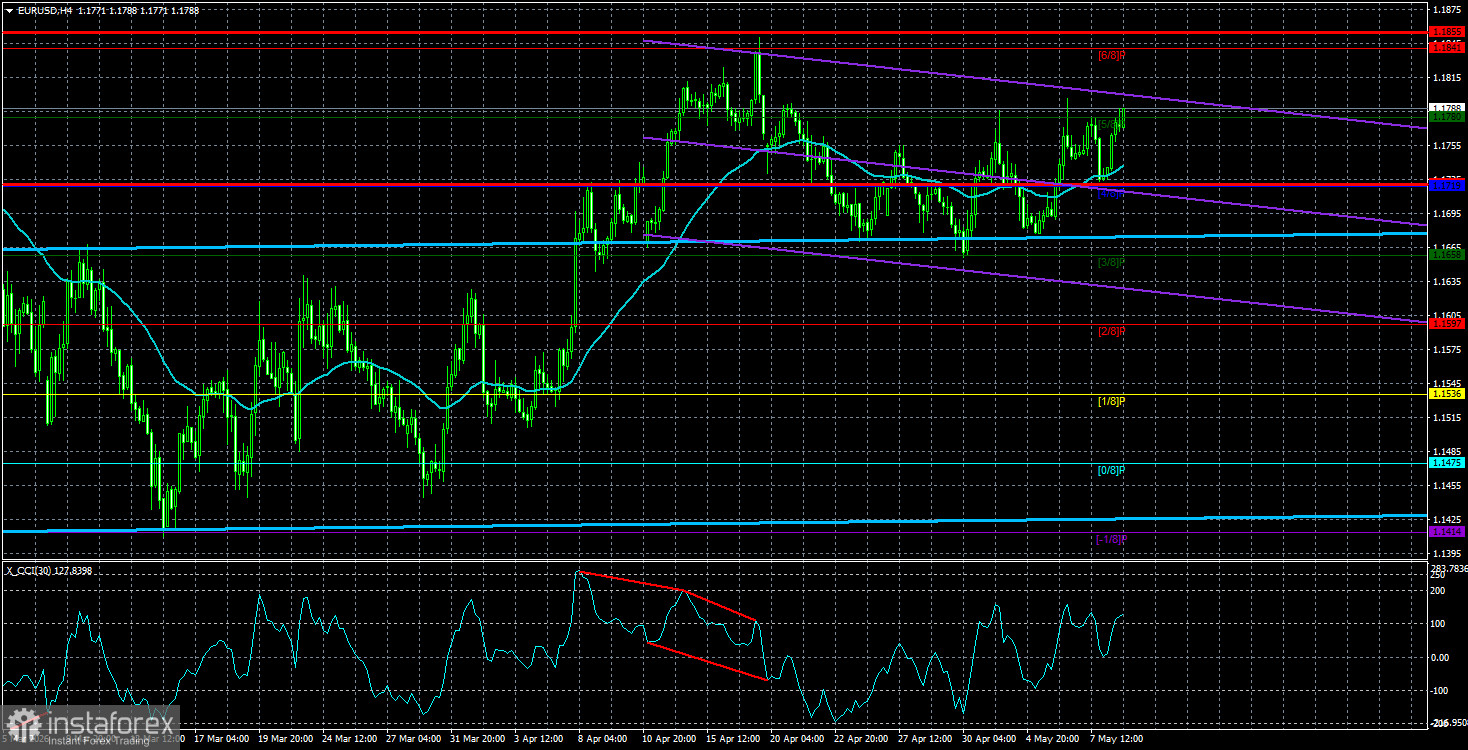
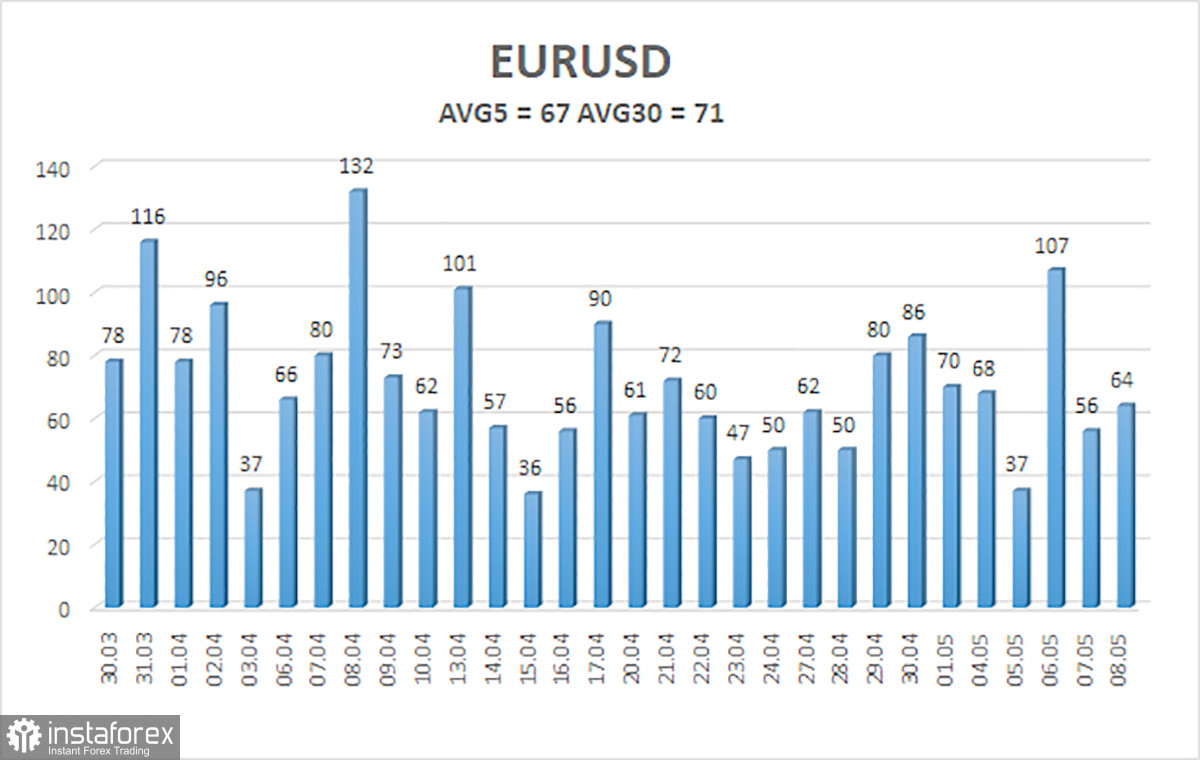
The average volatility of the EUR/USD currency pair over the last five trading days as of May 11 is 67 pips and is categorized as "average." We expect the pair to trade between 1.1721 and 1.1855 on Monday. The upper linear regression channel has flattened, indicating a change in trend to an upward direction. In fact, the upward trend from 2025 could have resumed a month ago. The CCI indicator has entered overbought territory and formed two "bearish" divergences, signaling the start of a downward correction that is likely already complete.
Nearest Support Levels:
S1 – 1.1780
S2 – 1.1719
S3 – 1.1658
Nearest Resistance Levels:
R1 – 1.1841
R2 – 1.1902
R3 – 1.1963
Trading Recommendations:
The EUR/USD pair maintains an upward trend amid diminishing geopolitical influence on market sentiment and decreasing geopolitical tensions. The global fundamental backdrop for the dollar remains extremely negative, so in the long term, we still expect the pair to rise. If the price is below the moving average, short positions can be considered with targets at 1.1658 and 1.1597 based on technical grounds. Above the moving average line, long positions are relevant with targets at 1.1841 and 1.1855. The market continues to drift away from geopolitical factors, and the dollar continues to lose its only growth driver.
Explanations for the Illustrations:
- Linear Regression Channels help identify the current trend. If both are pointing in the same direction, it indicates a strong trend.
- The Moving Average Line (settings 20,0, smoothed) indicates the short-term trend and the direction in which trading should currently proceed.
- Murray Levels serve as target levels for movements and corrections.
- Volatility Levels (red lines) indicate the likely price channel in which the pair will trade over the coming days, based on current volatility metrics.
- CCI Indicator: Its entry into the oversold area (below -250) or the overbought area (above +250) signifies that a trend reversal in the opposite direction is approaching.